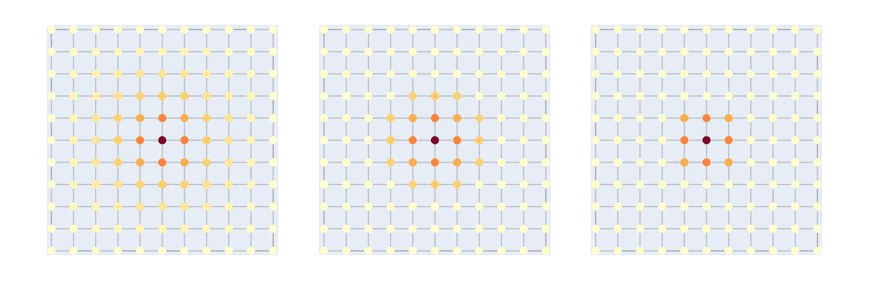
Potential theory, first developed in the study of partial differential equations, finds in this work an extension to the discrete setting of graphs and networks. In its classical form, the theory uses tools for understanding how functions behave within a region when only their values at the boundary are known. This project examines how that same perspective may be carried over to networks. The aim is to develop and test a framework for weighted graphs that runs parallel to the continuum theory. The methodological approach proceeds by way of computational experiment, conducted across several families of networks which includes regular grids, random geometric graphs, and small-world models among them. These experiments test formulae that reproduce harmonic functions on graphs, examine the behaviour of the Green's function in networks of varying density, and analyse operators that capture information at graph boundaries. We focused on random geometric graphs of increasing size to study how spectral properties approach the continuum limit as the network grows denser- that is, to observe the discrete reaching, by degrees, toward the continuous from which it was abstracted.